E-Commerce SEO: 15 Proven Tips to Increase Sales in 2025
Boost your online store sales with proven e-commerce SEO strategies. Learn keyword research, product page optimization, and technical SEO tips that drive traffic and revenue.

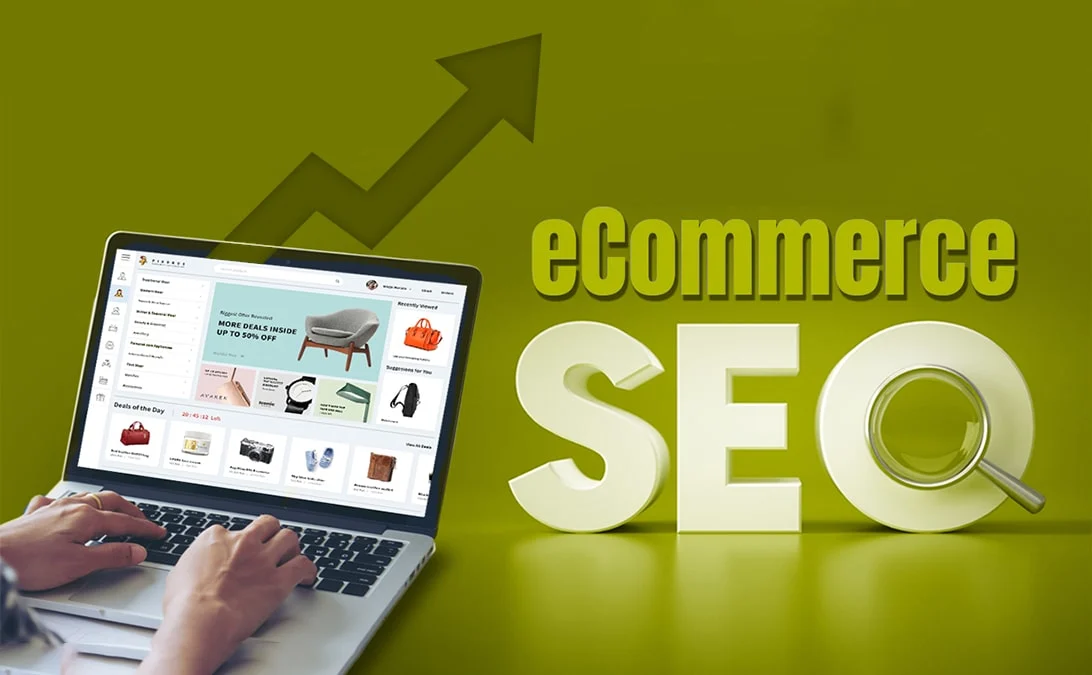
Running an online store without proper SEO is like opening a shop in a hidden alley—nobody knows you exist. According to recent data, 44% of online shoppers start their product search on Google, and if your store doesn't appear in those results, you're losing customers to competitors.
I'm Sadekur Rahman, an SEO Specialist with over 4 years of experience helping e-commerce businesses grow their online presence. I've worked with 220+ websites across different industries, and I've seen firsthand how the right SEO strategy can transform an struggling online store into a profitable business.
In this comprehensive guide, I'll share 15 actionable e-commerce SEO tips that have helped my clients increase their organic traffic, improve rankings, and most importantly—boost sales. Whether you're running a Shopify store, WooCommerce site, or custom platform, these strategies will work for you.
What Is E-Commerce SEO?
E-commerce SEO is the process of optimizing your online store to rank higher in search engine results pages. Unlike regular SEO, e-commerce SEO focuses specifically on product pages, category pages, and the unique challenges of online retail.
The goal is simple: get your products in front of people who are actively searching to buy them.
When done correctly, e-commerce SEO helps you:
- Increase organic traffic from search engines
- Attract high-intent buyers ready to purchase
- Reduce dependency on paid advertising
- Build long-term, sustainable traffic
- Improve user experience and conversion rates
Why E-Commerce SEO Matters in 2025
The e-commerce landscape is more competitive than ever. With millions of online stores fighting for attention, organic search has become one of the most reliable ways to stand out.
Here's why e-commerce SEO should be your priority:
Cost-Effective: Unlike paid ads that stop working when you stop paying, SEO delivers ongoing traffic without continuous investment.
High-Intent Traffic: People searching for products on Google are already in buying mode. They have their credit cards ready—you just need to show up.
Trust and Credibility: Websites ranking on the first page of Google are perceived as more trustworthy and established.
Competitive Advantage: Many e-commerce stores still neglect SEO, giving you an opportunity to outrank them.
According to Ahrefs, 96.55% of websites don't get any organic traffic from Google. Don't be part of that statistic. Let's make sure your store is in the top 3.45% that actually ranks.
15 Proven E-Commerce SEO Tips to Increase Sales
1. Master E-Commerce Keyword Research
Keyword research is the foundation of any successful e-commerce SEO strategy. But not all keywords are created equal for online stores.
Focus on These Keyword Types:
Transactional Keywords: These indicate buying intent. Examples: "buy running shoes online," "iPhone 14 Pro Max price," "order laptop with free shipping."
Commercial Keywords: Used by buyers comparing options. Examples: "best gaming laptop 2025," "iPhone vs Samsung," "top-rated coffee makers reviews."
Product-Specific Keywords: Include brand, model, and specs. Examples: "Nike Air Max 270 black," "Samsung 55-inch QLED TV."
Long-Tail Keywords: More specific, less competition. Examples: "waterproof hiking boots for women size 8," "organic cotton baby clothes under $30."
How to Find E-Commerce Keywords:
- Use Amazon's search bar—type your product and see what auto-completes
- Check Google's "People Also Ask" and related searches
- Use keyword tools like Ahrefs, SEMrush, or Ubersuggest
- Analyze competitor rankings
- Look at Google Search Console data
Pro Tip: Focus on keywords with buying intent rather than just high search volume. A keyword with 500 monthly searches and high buying intent is better than one with 5,000 searches but no intent.
2. Optimize Product Page Titles
Your product page title tag is the single most important on-page SEO element. It appears in search results and tells both Google and users what your page is about.
Best Practices for Product Titles:
- Include the product name, brand, and key specifications
- Keep titles between 50-60 characters
- Make every title unique
- Put important keywords toward the beginning
- Make it readable for humans, not just search engines
Bad Example: "Galaxy S21 – Smartphone"
Good Example: "Samsung Galaxy S21 128GB – 6.2″ Android Smartphone"
The good example includes brand, model, storage capacity, and screen size—covering multiple search terms while remaining readable.
For my e-commerce SEO services, I've helped clients see 40-60% increases in click-through rates just by optimizing product titles correctly.
3. Write Unique Product Descriptions
One of the biggest mistakes e-commerce stores make is using manufacturer descriptions or copying content from other sites. Google penalizes duplicate content, and generic descriptions don't convert.
How to Write SEO-Friendly Product Descriptions:
- Write 300-500 words minimum for main products
- Include primary and secondary keywords naturally
- Focus on benefits, not just features
- Address common questions and concerns
- Use bullet points for easy scanning
- Include technical specifications
- Add social proof (reviews, ratings)
Structure Your Descriptions Like This:
- Opening paragraph: Main benefit and unique selling point
- Features section: What makes this product special
- Benefits section: How it solves customer problems
- Specifications: Technical details in bullet points
- Usage tips: How to get the most from the product
Remember: Your description should sell AND rank. Write for humans first, optimize for search engines second.
4. Optimize Category Pages
Category pages are often overlooked in e-commerce SEO, but they're goldmines for traffic. A well-optimized category page can rank for dozens of high-value keywords.
Category Page Optimization Checklist:
- Create unique, keyword-rich category descriptions (200-300 words minimum)
- Include H1 tag with category name
- Add breadcrumb navigation
- Use descriptive URLs (e.g., /mens-running-shoes instead of /category-123)
- Include filter options (size, color, price range)
- Add internal links to related categories
- Optimize category meta descriptions
Pro Tip: According to Shopify's data, ranking a collection page often performs better than ranking individual product pages because it shows shoppers your entire inventory for that category.
5. Implement Structured Data (Schema Markup)
Structured data helps Google understand your product information and display it richly in search results. This includes star ratings, prices, availability, and more.
Essential Schema Types for E-Commerce:
- Product Schema: Shows product details in search results
- Review Schema: Displays star ratings and review counts
- Offer Schema: Shows price and availability
- Organization Schema: Shares business information
- Breadcrumb Schema: Shows navigation path
Products with rich snippets get 30-40% higher click-through rates compared to standard listings.
You can implement schema using:
- JSON-LD code (recommended by Google)
- Shopify apps or WordPress plugins
- Google's Structured Data Markup Helper
Need help implementing structured data? My SEO services include complete technical SEO optimization.
6. Improve Site Speed and Performance
Page speed is a confirmed Google ranking factor, and it directly impacts your conversion rate. Amazon found that every 100ms delay costs them 1% in sales.
How to Speed Up Your E-Commerce Site:
- Compress and optimize images (use WebP format)
- Enable browser caching
- Use a Content Delivery Network (CDN)
- Minify CSS, JavaScript, and HTML
- Enable lazy loading for images
- Choose faster hosting
- Reduce redirects
- Remove unnecessary plugins
Tools to Test Your Speed:
- Google PageSpeed Insights
- GTmetrix
- Pingdom
Aim for a page load time under 3 seconds on mobile and 2 seconds on desktop.
7. Optimize for Mobile-First Indexing
Google now uses the mobile version of your site for indexing and ranking. If your mobile experience is poor, your rankings will suffer.
Mobile Optimization Essentials:
- Use responsive design
- Make buttons and links easy to tap
- Optimize images for mobile screens
- Simplify navigation for small screens
- Use larger, readable fonts (minimum 16px)
- Reduce pop-ups and interstitials
- Test on real mobile devices
According to recent data, 60-70% of e-commerce traffic comes from mobile devices. If your site isn't mobile-friendly, you're losing money.
8. Create SEO-Friendly URLs
Your URL structure should be clean, descriptive, and keyword-rich.
Good URL Structure:
- yourstore.com/mens-running-shoes/nike-air-max-270
- yourstore.com/category/product-name
Bad URL Structure:
- yourstore.com/product?id=12345
- yourstore.com/shop/category1/subcategory2/product-name-long-version-with-too-many-words
Best Practices:
- Keep URLs short (under 100 characters)
- Use hyphens, not underscores
- Include target keywords
- Avoid unnecessary parameters
- Use lowercase letters
9. Build High-Quality Backlinks
Backlinks remain one of the top three ranking factors. The more authoritative websites link to you, the more Google trusts your store.
E-Commerce Link Building Strategies:
- Create shareable content (buying guides, comparisons)
- Reach out to industry blogs for product reviews
- Get featured in gift guides and roundup articles
- Partner with influencers and bloggers
- Create data-driven research or infographics
- Submit to relevant directories
- Leverage supplier and manufacturer links
Quality matters more than quantity. One link from a trusted industry site is worth 100 links from spam sites.
Need help building authoritative backlinks? Check my backlink building services.
10. Leverage Customer Reviews
Customer reviews don't just build trust—they're powerful SEO assets. Reviews add fresh, unique content to your pages and often include natural keywords.
How to Use Reviews for SEO:
- Enable reviews on all product pages
- Implement review schema markup
- Encourage customers to leave detailed reviews
- Respond to all reviews (shows engagement)
- Feature reviews prominently on product pages
- Create review roundup content
- Use review content in meta descriptions
Studies show that products with reviews can rank 10-15% higher than those without.
11. Optimize Images for SEO
Product images are crucial for e-commerce, but they're often overlooked for SEO.
Image Optimization Checklist:
- Use descriptive file names (red-running-shoes.jpg, not IMG_1234.jpg)
- Write detailed alt text with keywords
- Compress images (aim for under 100KB)
- Use WebP format when possible
- Include product images in image sitemaps
- Use multiple images per product
- Add captions where relevant
Properly optimized images can:
- Appear in Google Image Search
- Improve page load speed
- Help visually impaired users
- Provide context to search engines
Recommended Tool: CrunchyPic for Image Optimization
Need to compress product images without installing software? CrunchyPic is a free, browser-based image toolkit that lets you compress, convert, resize, and crop images without signing up or adding watermarks.
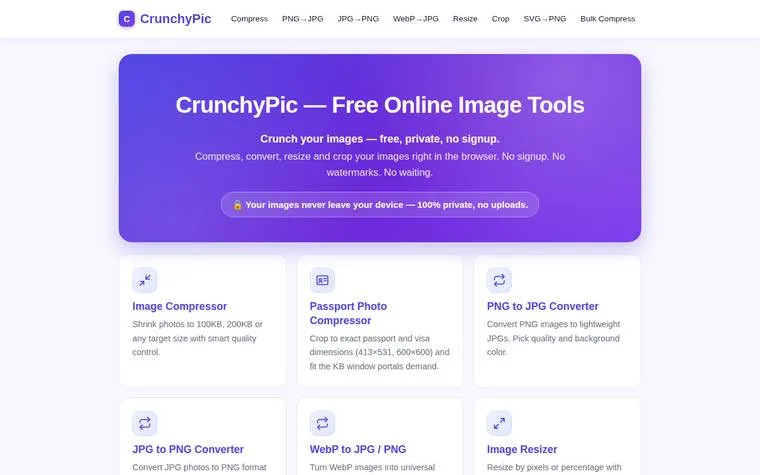
You can use its compress image to 100KB tool to reduce large product photos to your target file size before uploading them to your store. You can also export images in WebP format to help improve page loading speed.
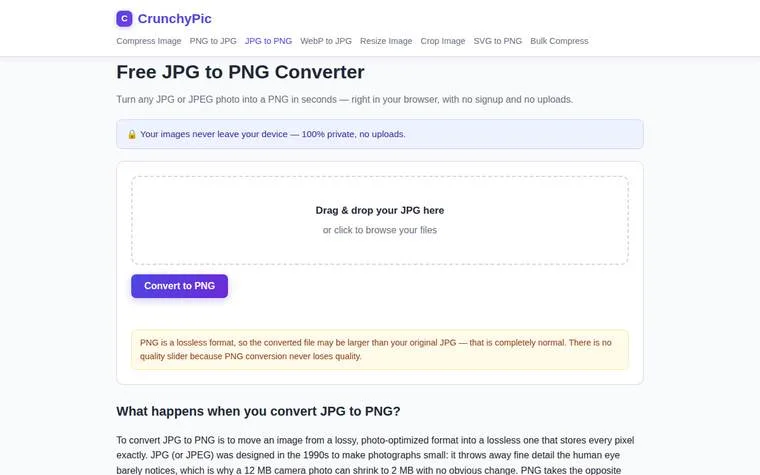
It’s a convenient option for store owners who want to optimize product images quickly and keep their websites lightweight.
12. Implement Internal Linking Strategy
Internal links help Google discover your pages, understand your site structure, and distribute link authority throughout your store.
Smart Internal Linking for E-Commerce:
- Link from category pages to individual products
- Link related products to each other
- Create "You might also like" sections
- Link from blog posts to relevant products
- Add breadcrumb navigation
- Include links in product descriptions
- Create filter and facet pages that are crawlable
Example: If you sell running shoes, link from:
- The running shoes category to specific shoe models
- Individual shoe pages to complementary products (socks, insoles)
- Blog posts about running to relevant shoe categories
13. Optimize for Voice Search
Voice search is growing rapidly. By 2025, 50% of all searches are expected to be voice-based.
Voice Search Optimization Tips:
- Target long-tail, conversational keywords
- Create FAQ pages answering common questions
- Use natural language in your content
- Optimize for local searches ("near me" queries)
- Implement schema markup
- Aim for featured snippet positions
Voice Search Examples:
- "What's the best running shoe for flat feet?"
- "Where can I buy organic baby clothes near me?"
- "How much does a MacBook Pro cost?"
Structure your content to answer these questions directly.
14. Avoid Common E-Commerce SEO Mistakes
Learn from the mistakes I've seen hundreds of stores make:
Duplicate Content: Having the same product descriptions across multiple pages confuses Google and dilutes your rankings.
Thin Content: Product pages with only 50-100 words don't rank well. Add substantial, valuable content.
Poor Site Architecture: If products are buried 5+ clicks deep, Google may never find them. Keep important pages within 3 clicks of the homepage.
Ignoring Out-of-Stock Products: Don't delete these pages. Keep them live with "notify when back in stock" options to maintain SEO value.
Blocking Important Pages: Check your robots.txt file to ensure you're not accidentally blocking category or product pages from being crawled.
Missing Canonical Tags: Use canonical tags to indicate your preferred version when you have similar pages.
15. Track, Measure, and Improve
SEO isn't a one-time task. You need to continuously monitor performance and make improvements.
Key Metrics to Track:
- Organic traffic (overall and per page)
- Keyword rankings
- Conversion rate from organic traffic
- Bounce rate and time on site
- Page load speed
- Crawl errors
- Backlink profile
Essential Tools:
- Google Search Console (free)
- Google Analytics (free)
- Ahrefs or SEMrush (paid)
- Google PageSpeed Insights (free)
Set up monthly reviews to identify what's working and what needs improvement.
For comprehensive tracking and ongoing optimization, explore my SEO services.
Technical SEO for E-Commerce Stores
Beyond on-page optimization, technical SEO ensures your site is crawlable, fast, and secure.
Essential Technical Elements:
XML Sitemap: Submit product and category sitemaps to Google Search Console to help them find your pages faster.
HTTPS Security: SSL certificates are a ranking factor and build customer trust. All e-commerce sites must use HTTPS.
Robots.txt File: Control which pages search engines can crawl. Be careful not to block important pages.
Canonical Tags: Prevent duplicate content issues when you have similar products or filtering systems.
Pagination: Implement pagination correctly for category pages with many products.
404 Error Management: Fix broken links and redirect removed products to similar alternatives.
For complete technical SEO audits and fixes, check out my programmatic SEO services.
Content Marketing for E-Commerce SEO
Product pages alone won't capture all your potential traffic. You need a content strategy that targets buyers at different stages.
Content Ideas for E-Commerce Stores:
Buying Guides: "How to Choose the Perfect Running Shoes for Your Foot Type"
Product Comparisons: "iPhone 15 vs Samsung S24: Which Should You Buy?"
How-To Articles: "How to Style White Sneakers: 10 Outfit Ideas"
Trend Articles: "Top Fashion Trends for Spring 2025"
Problem-Solution Content: "5 Ways to Make Your Shoes Last Longer"
Industry News: "New Regulations for Organic Food Labeling"
Each piece of content should link back to relevant products and categories. This strategy helps you:
- Target informational keywords
- Build topical authority
- Attract customers early in the buying journey
- Generate natural backlinks
My content writing services can help you create high-quality, SEO-optimized content that drives traffic and sales.
Local SEO for E-Commerce (If You Have Physical Locations)
If you have brick-and-mortar stores in addition to your online shop, local SEO is crucial.
Local SEO Checklist:
- Claim and optimize your Google Business Profile
- Ensure NAP (Name, Address, Phone) consistency across all platforms
- Get reviews on Google and other local directories
- Create location-specific pages
- Build local citations
- Use local keywords ("buy furniture in Dhaka")
- Implement local business schema
Learn more about optimizing for local searches with my local SEO services.
Conversion Rate Optimization for E-Commerce
Getting traffic is only half the battle. You need to convert visitors into customers.
CRO Best Practices:
- Clear, prominent call-to-action buttons
- Simplified checkout process
- Multiple payment options
- Trust signals (security badges, money-back guarantees)
- High-quality product images and videos
- Customer testimonials and reviews
- Live chat support
- Exit-intent pop-ups with offers
- A/B testing different elements
Even a 1% improvement in conversion rate can significantly impact your revenue.
For professional CRO services, visit my conversion rate optimization page.
Frequently Asked Questions
How long does it take to see results from e-commerce SEO?
E-commerce SEO typically takes 3-6 months to show noticeable results, with significant improvements appearing around 6-12 months. However, this timeline depends on several factors:
- Your website's current state and authority
- Competition in your niche
- Quality and consistency of your SEO efforts
- Your website's technical health
- How quickly you implement changes
Quick wins (like fixing technical errors) can show results in weeks, while competitive keyword rankings take longer.
What's the difference between e-commerce SEO and regular SEO?
E-commerce SEO focuses specifically on optimizing online stores with unique challenges:
- Thousands of product pages to optimize
- Managing duplicate content across similar products
- Handling out-of-stock items
- Optimizing for transactional keywords
- Product feed optimization for Google Shopping
- Review and rating optimization
- Category and filter page optimization
Regular SEO typically focuses on informational content and service pages.
Can I do e-commerce SEO myself or should I hire an expert?
You can learn basic e-commerce SEO and implement many strategies yourself. However, hiring an expert makes sense if:
- You lack time to learn and implement SEO
- Your store has technical issues you can't fix
- You're in a highly competitive niche
- You want faster, more reliable results
- You need comprehensive strategy and execution
As an SEO specialist with 4+ years of experience and 220+ websites optimized, I can help you avoid costly mistakes and achieve results faster. Book a free consultation to discuss your specific needs.
Should I focus on Google Shopping or organic SEO?
Both! They complement each other:
Google Shopping: Immediate visibility, requires ad spend, great for quick sales Organic SEO: Long-term sustainability, no ongoing ad costs, builds authority
The best strategy uses both channels. Optimize your product feed for Shopping while building organic SEO for lasting traffic.
Real Results from E-Commerce SEO
Let me share some results I've achieved for e-commerce clients:
Case Study 1 - Fashion E-Commerce Store:
- Increased organic traffic by 285% in 8 months
- Improved conversion rate from 0.8% to 2.4%
- Revenue from organic search increased by 340%
Case Study 2 - Electronics Store:
- Ranked 15 product categories on page 1
- Reduced cost per acquisition by 67%
- Organic traffic became the #1 revenue source
Case Study 3 - Home Decor Store:
- Grew from 500 to 12,000 monthly organic visitors
- 156 keywords ranking in top 10
- ROI of 450% within first year
Want results like these for your store? Explore my case studies or check my pricing.
Tools I Recommend for E-Commerce SEO
Here are the tools I use regularly for my clients:
Keyword Research:
- Ahrefs
- SEMrush
- Ubersuggest
- Google Keyword Planner
Technical SEO:
- Google Search Console
- Screaming Frog
- GTmetrix
- Google PageSpeed Insights
On-Page SEO:
- Yoast SEO (WordPress)
- Rank Math (WordPress)
- Shopify SEO Apps
Analytics:
- Google Analytics
- Hotjar (heat maps)
- Microsoft Clarity (free heat maps)
Backlink Analysis:
- Ahrefs
- Moz
- Majestic SEO
Take Action: Your E-Commerce SEO Roadmap
Ready to implement these strategies? Here's your action plan:
Month 1: Foundation
- Conduct keyword research
- Fix technical SEO issues
- Optimize product titles and descriptions
- Implement schema markup
Month 2-3: Content & On-Page
- Create category page content
- Optimize images
- Build internal linking structure
- Start creating blog content
Month 4-6: Authority Building
- Execute link building campaigns
- Encourage customer reviews
- Optimize for conversions
- Monitor and adjust based on data
Ongoing:
- Add new products with proper optimization
- Create fresh content monthly
- Build backlinks consistently
- Track metrics and improve
Why Choose Sadekur Rahman for Your E-Commerce SEO?
As an SEO specialist with over 4 years of experience, I've helped 185+ businesses and optimized 220+ websites across Bangladesh, USA, Australia, and Canada.
What makes my approach different:
✓ Data-Driven Strategy: Every decision based on analytics and testing ✓ White-Hat Techniques: Only ethical SEO methods that last ✓ Transparent Reporting: Monthly reports showing exactly what we're doing ✓ Proven Results: Real case studies with measurable outcomes ✓ Comprehensive Service: From technical fixes to content creation ✓ E-Commerce Focus: Specialized experience with online stores
My e-commerce SEO services include:
- Complete technical SEO audits
- Keyword research and strategy
- Product page optimization
- Content creation
- Link building
- Conversion rate optimization
- Ongoing monitoring and improvements
Ready to Grow Your E-Commerce Store?
E-commerce SEO isn't optional anymore—it's essential for survival in today's competitive online market. The strategies I've shared have helped countless stores increase their organic traffic, improve rankings, and boost sales.
But knowledge alone isn't enough. You need implementation, consistency, and expertise to see real results.
Let's talk about your store:
📞 Book a Free Strategy Call: Schedule here
💼 Explore My Services: View all services
💰 Check Pricing Plans: See pricing options
📧 Contact Me: Get in touch
Don't let your competitors dominate the search results while you're invisible. Every day you delay is another day of lost sales and missed opportunities.
Start your e-commerce SEO journey today, and let's turn your online store into a traffic-generating, revenue-producing machine.About the Author: Sadekur Rahman (Mr. Sadekur) is an SEO Specialist with 4+ years of experience helping businesses improve their online visibility. He currently works as an SEO Executive at Daily Amar Desh and has helped 185+ businesses optimize 220+ websites across Bangladesh and internationally. Learn more or get in touch.

Written by Sadekur Rahman
SEO & Website Strategy Specialist at Pixelvega and SEO Executive at Daily Amar Desh. 6+ years helping brands grow with data-driven SEO.